This is an old revision of the document!
Block 20 — Electromagnetic Induction and Energy
Learning objectives
- …
Preparation at Home
Well, again
- read through the present chapter and write down anything you did not understand.
- Also here, there are some clips for more clarification under 'Embedded resources' (check the text above/below, sometimes only part of the clip is interesting).
For checking your understanding please do the following exercises:
- …
90-minute plan
- Warm-up (x min):
- ….
- Core concepts & derivations (x min):
- …
- Practice (x min): …
- Wrap-up (x min): Summary box; common pitfalls checklist.
Conceptual overview
- …
Core content
…
Common pitfalls
- …
Exercises
Exercise E1 Self-Induction
(written test, approx. 8 % of a 120-minute written test, SS2024)
A coil with a length of $30 ~\rm cm$ and a radius of $2 ~\rm cm$ has $500$ turns.
The current through the coil changes linearly from $0$ to $3 ~\rm A$ in $0.02 ~\rm ms$.
The arrangement is located in air ($\mu_{\rm r}=1$).
$\mu_0= 4\pi \cdot 10^{-7} ~\rm Vs/Am$
1. Calculate the (self-)inductance of the coil.
2. Determine the induced voltage in the coil during the change in current.
Exercise E12 Self Induction
(written test, approx. 8 % of a 120-minute written test, SS2022)
Accidentally, a motor with an inductance of $L=50 ~\rm \mu H$ is connected to a DC voltage source, which is fused with a circuit breaker.
The circuit breaker opens the circuit At $t_0=0$ with a current of $I=63 ~\rm A$. The current is reduced linearly down to $0 ~\rm A$ within $1 ~\rm \mu s$.
(The inner resistance of the motor shall be neglected.)
1. Draw the circuit (the circuit breaker can be drawn as a switch), with all voltage and current arrows.

2. What is the maximum magnitude of the voltage, which the circuit breaker has to withstand?
Sketch the diagrams $i(t)$ and $u_{\rm ind} (t)$ with the calculated value of the induced voltage.
- external voltage of the voltage source $U_\rm s$
- voltage $u_{\rm ind} (t)$ induced by the change of the current
The first one is not given in the exercise, and therefore not considered here.
The induced voltage can be calculated by linearizing the following: \begin{align*} u_{\rm ind} (t) &= - L {{ {\rm d} i}\over{ {\rm d} t }}\\ \rightarrow u_{\rm ind} (t) &= - L {{ \Delta i}\over{ \Delta t }}\\ \end{align*}
With the given details: \begin{align*} u_{\rm ind} (t) &= - L {{ 0 - I}\over{ t_1 - t_0 }}\\ &= 50 \cdot 10^{-6} {~\rm H} {{ 63 ~\rm A}\over{ 1 \cdot 10^{-6} ~\rm s}}\\ &= 3150 {{ ~\rm Vs}\over{ ~\rm A}} \; {{ ~\rm A}\over{ ~\rm s}}\\ \end{align*}

Exercise E12 Coil in a magnetic Field
(written test, approx. 4 % of a 120-minute written test, SS2021)
A coil with $n = 300$ turns and a cross-sectional area $A = 600 ~\rm cm^2$ is located in a homogeneous magnetic field.
The rotation of the coil causes a sinusoidal change in the magnetic field in the coil with the frequency $f = 80~\rm Hz$.
The maximum value of the magnetic flux density in the coil is $\hat{B} = 2 \cdot 10^{-6} ~\rm {{Vs}\over{cm^2}}$.
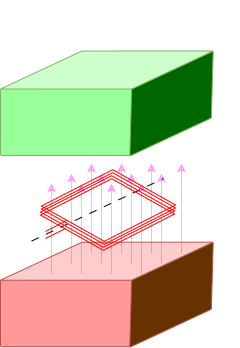
Derive the formula for the voltage induced in the coil and calculate the voltage amplitude.
The induced voltage $u_{\rm ind}$ is given by:
\begin{align*} u_{\rm ind} &= - {{{\rm d}\Psi(t)}\over{{\rm d}t}} \\ &= - n{{{\rm d}\Phi(t)}\over{{\rm d}t}} \\ \end{align*}
With $\Phi(t)= B(t) \cdot A$, where $A$ is the constant area of a single winding and $B(t)$ is the changing field through this winding.
Due to the rotation, the field changes as:
\begin{align*} B(t) &= \hat{B} \cdot \sin(\omega t + \varphi) \\ &= \hat{B} \cdot \sin(2\pi f \cdot t + \varphi) \\ \end{align*}
This leads to: \begin{align*} u_{\rm ind} &= - n{{{\rm d}}\over{{\rm d}t}}A \hat{B} \cdot \sin(2\pi f \cdot t + \varphi) \\ &= - n \cdot A \hat{B} \cdot 2\pi f \cdot \cos(2\pi \cdot f t + \varphi) \\ \end{align*}
The absolute value of the factor in front of the $\cos$ is the maximum induced voltage $\hat{U}_{\rm ind}$: \begin{align*} \hat{U}_{\rm ind} &= n \cdot A \hat{B} \cdot 2\pi f \\ &= 300 \cdot 0.06{~\rm m^2} \cdot 2 \cdot 10^{-2} ~\rm {{Vs}\over{m^2}} \cdot 2\pi \cdot 80 {{1}\over{\rm s}} \\ &= 180.95... {~\rm m^2} \cdot {{\rm Vs}\over{\rm m^2}} \cdot {{1}\over{\rm s}} \\ &= 180.95... {~\rm V} \\ \end{align*}
Exercise E11 effect of induction
(written test, approx. 5 % of a 120-minute written test, SS2021)
A single conductor loop is penetrated by a changing magnetic flux.
The following figure shows the variation of the flux $\Phi(t)$ over time.
Calculate the variation of the induced voltage $u_{\rm ind}(t)$ over time and draw it in a separate diagram.

Based on Faraday's Law of Induction the induced voltage is given by: \begin{align*} u_{\rm ind} =& - {{ {\rm d} }\over{ {\rm d}t}} \Psi(t) \bigg\rvert_{n=1}\\ =& - {{ {\rm d} }\over{ {\rm d}t}} \Phi(t) \\ \end{align*}
For a linear function, the derivative can be substituted by Deltas ($\rm d \rightarrow \Delta$):
\begin{align*}
u_{\rm ind} = - {{ \Delta \Phi(t)}\over{ \Delta t}} = - { { \Phi(t_{\rm n+1} ) - \Phi(t_{\rm n} ) } \over { t_{\rm n+1} - t_{\rm n} } } \\
\end{align*}
For a piece-wise linear function, the induced voltage can be calculated for each interval.
Here, there are 5 different intervals - in the following called $\rm I$ to $\rm V$ from left to right:

- For the intervals $\rm I$, $\rm III$, and $\rm V$ , the flux $\Phi(t)$ is constant. Therefore, $\Delta \Phi(t)=0$ and $u_{\rm ind}(t)=0{~\rm V}$

- For the interval $\rm II$:
- The change in the flux is: $ \Delta \Phi(t) = 1.5 \cdot 10^{-4} {~\rm Vs} - 4.5 \cdot 10^{-4} {~\rm Vs}= - 3.0 \cdot 10^{-4} {~\rm Vs}$
- The time span is: $0.2 ~\rm s$
- Conclusively, the induced voltage is: $u_{\rm ind}(t) = + {{3.0 \cdot 10^{-4} {~\rm Vs}} \over {0.2 ~\rm s} } = 1.5 {~\rm mV}$

- For the interval $\rm IV$:
- The change in the flux is: $ \Delta \Phi(t) = 0 \cdot 10^{-4} {~\rm Vs} - 1.5 \cdot 10^{-4} {~\rm Vs}= - 1.5 \cdot 10^{-4} {~\rm Vs}$
- The time span is: $0.2 ~\rm s$
- Conclusively, the induced voltage is: $u_{\rm ind}(t) = + {{1.5 \cdot 10^{-4} {~\rm Vs}} \over {0.2 ~\rm s} } = 0.75 {~\rm mV}$


Embedded resources
Explanation (video): …