Table of Contents
Block 13 - Capacitor Circuits and Energy
13.0 Intro
13.0.1 Learning Objectives
- identify series vs. parallel connections of capacitors from a circuit diagram,
- compute equivalent capacitance $C_{\rm eq}$ for series and parallelnetworks,
- use the key sharing rules: in series $Q_k=\text{const.}$ and voltages divide; in parallel $U_k=\text{const.}$ and charges divide,
- apply the capacitor divider relation (two series capacitors),
- determine stored energy, including a dimensional check to $\rm J$.
13.0.2 Preparation at Home
Well, again
- read through the present chapter and write down anything you did not understand.
- Also here, there are some clips for more clarification under 'Embedded resources' (check the text above/below, sometimes only part of the clip is interesting).
For checking your understanding please do the following exercises:
- 5.9.5
13.0.3 90-minute plan
- Warm-up (10 min):
- Quick quiz (2–3 items): series or parallel? which rule applies (constant $U$ or constant $Q$)?
- Recall $Q=C\,U$ and energy $W=\tfrac12 C U^2$ (units).
- Core concepts & derivations (35 min):
- Derive $C_{\rm eq}$ for series from Kirchhoff’s voltage law and $Q=\text{const.}$; derive voltage division $U_k=\dfrac{Q}{C_k}$.
- Derive $C_{\rm eq}$ for parallel from Kirchhoff’s current/charge balance and $U=\text{const.}$; obtain $Q_k=C_k U$.
- Energy in the electric field: integrate $dW=U\,dq$ → $W=\tfrac12 C U^2$; short dimensional check.
- Practice (35 min):
- Two short worked examples: mixed series/parallel network; two-capacitor divider with given $U$ (find $U_1$, $U_2$, $W$ on each).
- Short simulation tasks (use the two embedded Falstad circuits in this page): observe $U_k$, $Q_k$ when toggling the switch or changing values.
- Mini-problems: “double a plate area / halve distance” reasoning on $C$ and $W$.
- Wrap-up (10 min):
- Common-pitfalls checklist and one exit-ticket calculation.
13.0.4 Conceptual overview
- What stays the same? In series all capacitors carry the same charge $Q$; in parallel all capacitors see the same voltage $U$.
- How do totals form? Capacitances add inversely in series and add directly in parallel. This mirrors resistors but with the roles swapped.
- Voltage/charge sharing: In series, the smaller $C_k$ takes the larger $U_k$ ($U_k=Q/C_k$). In parallel, the larger $C_k$ takes the larger $Q_k$ ($Q_k=C_k U$).
- Energy viewpoint: Charging needs work against the field; $W=\tfrac12 C U^2=\tfrac12 Q U=\dfrac{Q^2}{2C}$. Dimensional check: $[C]=\rm F=\dfrac{A\,s}{V}$, so $[C U^2]=\dfrac{A\,s}{V}\,V^2=A\,s\,V=J$.
- Design intuition: Increasing plate area $A$ or dielectric $\varepsilon_r$ raises $C$ and thus stored $W$ at the same $U$; increasing gap $d$ lowers $C$.
13.1 Core content
13.1.1 Series Circuit of Capacitor
If capacitors are connected in series, the charging current $I$ into the individual capacitors $C_1 ... C_n$ is equal. Thus, the charges absorbed $\Delta Q$ are also equal: \begin{align*} \Delta Q = \Delta Q_1 = \Delta Q_2 = ... = \Delta Q_n \end{align*}
Furthermore, after charging, a voltage is formed across the series circuit, which corresponds to the source voltage $U_q$. This results from the addition of partial voltages across the individual capacitors. \begin{align*} U_q = U_1 + U_2 + ... + U_n = \sum_{k=1}^n U_k \end{align*}
It holds for the voltage $U_k = \Large{{Q_k}\over{C_k}}$.
If all capacitors are initially discharged, then $U_k = \Large{{\Delta Q}\over{C_k}}$ holds.
Thus
\begin{align*}
U_q &= &U_1 &+ &U_2 &+ &... &+ &U_n &= \sum_{k=1}^n U_k \\
U_q &= &{{\Delta Q}\over{C_1}} &+ &{{\Delta Q}\over{C_2}} &+ &... &+ &{{\Delta Q}\over{C_3}} &= \sum_{k=1}^n {{1}\over{C_k}}\cdot \Delta Q \\
{{1}\over{C_{ \rm eq}}}\cdot \Delta Q &= &&&&&&&&\sum_{k=1}^n {{1}\over{C_k}}\cdot \Delta Q
\end{align*}
Thus, for the series connection of capacitors $C_1 ... C_n$ :
\begin{align*} \boxed{ {{1}\over{C_{ \rm eq}}} = \sum_{k=1}^n {{1}\over{C_k}} } \end{align*} \begin{align*} \boxed{ \Delta Q_k = {\rm const.}} \end{align*}
For initially uncharged capacitors, (voltage divider for capacitors) holds: \begin{align*} \boxed{Q = Q_k} \end{align*} \begin{align*} \boxed{U_{ \rm eq} \cdot C_{ \rm eq} = U_{k} \cdot C_{k} } \end{align*}
In the simulation below, besides the parallel connected capacitors $C_1$, $C_2$,$C_3$, an ideal voltage source $U_q$, a resistor $R$, a switch $S$, and a lamp are installed.
- The switch $S$ allows the voltage source to charge the capacitors.
- The resistor $R$ is necessary because the simulation cannot represent instantaneous charging. The resistor limits the charging current to a maximum value.
- The capacitors can be discharged again via the lamp.
13.1.2 Parallel Circuit of Capacitors
If capacitors are connected in parallel, the voltage $U$ across the individual capacitors $C_1 ... C_n$ is equal. It is therefore valid:
\begin{align*} U_q = U_1 = U_2 = ... = U_n \end{align*}
Furthermore, during charging, the total charge $\Delta Q$ from the source is distributed to the individual capacitors. This gives the following for the individual charges absorbed: \begin{align*} \Delta Q = \Delta Q_1 + \Delta Q_2 + ... + \Delta Q_n = \sum_{k=1}^n \Delta Q_k \end{align*}
If all capacitors are initially discharged, then $Q_k = \Delta Q_k = C_k \cdot U$
Thus
\begin{align*}
\Delta Q &= & Q_1 &+ & Q_2 &+ &... &+ & Q_n &= \sum_{k=1}^n Q_k \\
\Delta Q &= &C_1 \cdot U &+ &C_2 \cdot U &+ &... &+ &C_n \cdot U &= \sum_{k=1}^n C_k \cdot U \\
C_{ \rm eq} \cdot U &= &&&&&&&& \sum_{k=1}^n C_k \cdot U \\
\end{align*}
Thus, for the parallel connection of capacitors $C_1 ... C_n$ :
\begin{align*} \boxed{ C_{ \rm eq} = \sum_{k=1}^n C_k } \end{align*} \begin{align*} \boxed{ U_k = {\rm const.}} \end{align*}
For initially uncharged capacitors, (charge divider for capacitors) holds: \begin{align*} \boxed{\Delta Q = \sum_{k=1}^n Q_k} \end{align*}
\begin{align*} \boxed{ {{Q_k}\over{C_k}} = {{\Delta Q}\over{C_{ \rm eq}}} } \end{align*}
In the simulation below, again, besides the parallel connected capacitors $C_1$, $C_2$,$C_3$, an ideal voltage source $U_q$, a resistor $R$, a switch $S$, and a lamp are installed.
13.1.3 Energy in the electric Field
Now we want to see how much energy is stored in a capacitor during charging. When we want to charge a capacior charges have be separated (see figure 1). This gets more and more difficult as more charges were moved, since these already moved charges create an electric field.

We already had a first look onto the energy in the electric field in block09.
There, we got:
\begin{align*} \Delta W &= \int \vec{F} d\vec{r} \\ &= q \int \vec{E} d\vec{r} \\ &= q \cdot U \\ dW &= dq \cdot U \end{align*}
Now, For a capacitor we include the formula for the capacitor $C = {{q}\over{U}}$, or better its rearranged version $U = {{q}\over{C}}$:
\begin{align*} dW &= dq \cdot {{q}\over{C}} \\ \int dW &= \int {{q}\over{C}} dq \end{align*}
Here we again see, that the needed energy portion $dW$ to move a portion $dq$ is also related to the already moved charges $q$.
To get the energy $Delta W$ needed to move all of the charges $$Q = \int dq$$ we have to integrate from $0$ to $Q$:
\begin{align*} \Delta W &= \int_0^Q dW \\ &= \int_0^Q {{q}\over{C}} dq \\ &= {{1}\over{2}}{{Q^2}\over{C}} \\ \end{align*} \begin{align*} \boxed{ \Delta W = {{1}\over{2}}{{Q^2}\over{C}} = {{1}\over{2}}QU = {{1}\over{2}}CQ^2 } \end{align*}
13.2 Common pitfalls
- Mixing up the rules: writing $C_{\rm eq}=C_1+C_2$ for series (wrong) or $\dfrac{1}{C_{\rm eq}}=\dfrac{1}{C_1}+\dfrac{1}{C_2}$ for parallel (wrong).
- Forgetting which quantity is equal: series $\Rightarrow Q_k=\text{const.}$, parallel $\Rightarrow U_k=\text{const.}$.
- Applying the resistive voltage divider $U_1=\dfrac{R_1}{R_1+R_2}U$ to capacitors. For capacitors in series it inverts: $U_1=\dfrac{C_2}{C_1+C_2}U$.
- Ignoring initial charge states: pre-charged capacitors reconnected will redistribute charge; use charge conservation on isolated nodes before using $Q=C\,U$.
- Dropping units or mixing forms of energy: always keep $W=\tfrac12 C U^2=\tfrac12 Q U=\dfrac{Q^2}{2C}$ and check $\rm J$.
13.3 Exercises
Task 5.8.1 Calculating a circuit of different capacitors
Task 5.9.1 Layered Capacitor Task
Exercise 5.9.2 Further capacitor charging/discharging practice Exercise
Exercise 5.9.3 Further practice charging the capacitor
Exercise 5.9.4 Charge balance of two capacitors
Exercise 5.9.5 Capacitor with glass plate

Two parallel capacitor plates face each other with a distance $d_{ \rm K} = 10~{ \rm mm}$. A voltage of $U = 3'000~{ \rm V}$ is applied to the capacitor. Parallel to the capacitor plates, there is a glass plate ($\varepsilon_{ \rm r, G}=8$) with a thickness $d_{ \rm G} = 3~{ \rm mm}$ in the capacitor.
- Calculate the partial voltages $U_{ \rm G}$ in the glass and $U_{ \rm A}$ in the air gap.
- What is the maximum thickness of the glass pane if the electric field $E_{ \rm 0, G} =12 ~{ \rm kV/cm}$ must not exceed?
Exercise E6 Capacitor
(written test, approx. 12 % of a 120-minute written test, SS2024)
Older capacitive pressure sensors are based on a parallel plate capacitor setup (see left-side image).
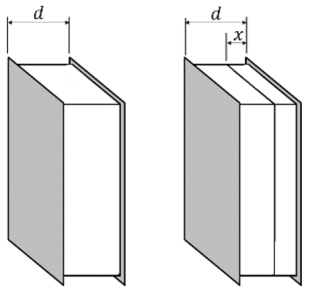
In the following such a sensor is given with:
- Plate area : $A=25 ~\rm mm^2$
- Distance between both plates: $d=200 ~\rm \mu m$
- Air between the plates: $\varepsilon_{\rm r,air}=1$
- Supply voltage: $3.3 ~\rm V$
- Boundary effects on the end of the layers shall be ignored in the following calculations.
$\varepsilon_{0} =8.854 \cdot 10^{-12} ~\rm F/m $
1. Calculate the capacity $C$.
2. Calculate the value of the displacement field between the plates, when a voltage of $U=3.3 ~\rm V$ is applied.
The displacement field is given by: \begin{align*} D &= \varepsilon_0 \varepsilon_r E \\ &= \varepsilon_0 \varepsilon_r {{U}\over{d}} \\ &= 8.854 \cdot 10^{-12} ~\rm As/Vm \cdot 1 \cdot {{3.3 {~\rm V} }\over{200 \cdot 10^{-6} {~\rm m} }} \\ \end{align*}
3. Calculate the charge difference between both plates for a voltage of $U=3.3 ~\rm V$.
4. Due to a production problem, the right-side layer is covered with a contaminant, see the right-side image.
The contaminant has $\varepsilon_{\rm r,c}>\varepsilon_{\rm r,air}$, while the distance between the plates remains the same.
Give a generalized formula $C_2=f(A,d,x,\varepsilon_{\rm r,c}, \varepsilon_{\rm r,air})$.
Therefore: \begin{align*} C = {{1}\over{ {{1}\over{C_{\rm air} }} + {{1}\over{ C_{\rm c}}} }} \end{align*}
With \begin{align*} C_{\rm air} &= \varepsilon_0 \varepsilon_{\rm r, air} {{A}\over{d-x}} &&= \varepsilon_0 A {{\varepsilon_{\rm r, air}}\over{d-x}} \\ C_{\rm c} &= \varepsilon_0 \varepsilon_{\rm r, c} {{A}\over{x}} &&= \varepsilon_0 A {{\varepsilon_{\rm r, c} }\over{x}} \\ \end{align*}
This leads to: \begin{align*} C = \varepsilon_0 A {{1}\over{ {{d-x}\over{\varepsilon_{\rm r, air} }} + {{x}\over{ \varepsilon_{\rm r, c}}} }} \end{align*}
Exercise E8 Capacitor
(written test, approx. 7 % of a 120-minute written test, SS2022)
Given is the multilayer capacitor shown below, with the following dimensions:
- Length of layer overlap: $l=1.5 ~\rm mm$
- Distance between single layers: $d=1.0 ~\rm \mu m$
- Depth of component: $w=0.7 ~\rm mm$
- Number of layers (as shown in the picture): 3 left-side and 3 right-side layers.
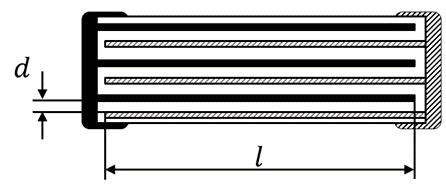
The material shall have a dielectric permittivity of $\varepsilon_r=3$.
The following calculations shall ignore boundary effects on the end of the layers.
$\varepsilon_0 = 8.854 \cdot 10^{-12} ~\rm As/Vm$
1. What is the field strength in the dielectric material between the layer, when a voltage of $U=6.3 ~\rm V$ is applied?
2. Calculate the capacity $C$.
The capacity can be derived from the geometry by: \begin{align*} C = \varepsilon_0 \varepsilon_r {{A}\over{d}} \end{align*}
For the area $A$ we have multiple plates with the area $A_0= l \cdot w$ facing each other.

How many “multiple plates” $N$ do we have to consider?
For this, we have to count facing areas $A_0$. There are $N=5$.

Therefore, the formula is \begin{align*} C &= \varepsilon_0 \varepsilon_r {{N \cdot l \cdot w}\over{d}} \\ &= 8.854 \cdot 10^{-12} ~\rm As/Vm \cdot 3 \cdot {{5 \cdot 1.5 \cdot 10^{-3} {~\rm m} \cdot 0.7 \cdot 10^{-3} {~\rm m} }\over{1 \cdot 10^{-6} {~\rm m} }} \end{align*}
3. Due to a production problem the left-side layers are covered with $d_{\rm c}=0.1 ~\rm \mu m$ of air ($\varepsilon_{r, \rm c}=1$), while the thickness of the dielectric material remains the same.
What is the new capacity $C_\rm c$?
The capacity of air is \begin{align*} C_{\rm Air} &= \varepsilon_0 \varepsilon_{r,\rm Air} {{N \cdot l \cdot w}\over{d_{\rm c}}} \\ &= 8.854 \cdot 10^{-12} ~\rm As/Vm \cdot 1 \cdot {{5 \cdot 1.5 \cdot 10^{-3} {~\rm m} \cdot 0.7 \cdot 10^{-3} {~\rm m} }\over{0.1 \cdot 10^{-6} {~\rm m} }} \\ &= 0.465... ~\rm nF \end{align*}
By this the overall capacity is \begin{align*} C_{\rm c} &= {{0.139... ~\rm nF \cdot 0.465... ~\rm nF}\over{0.139... ~\rm nF + 0.465... ~\rm nF}} \end{align*}
Embedded resources
The equivalent capacitor for series of parallel configuration is well explained here