This is an old revision of the document!
Block 15 — Magnets, their Effects and Fieldline Images
Learning objectives
- know that forces act between magnetic poles and know the direction of the forces.
- know that a magnetic field is formed around a current-carrying conductor.
- be able to sketch the field lines of the magnetic field. Know the direction of the field and where the field is densest.
Preparation at Home
Well, again
- read through the present chapter and write down anything you did not understand.
- Also here, there are some clips for more clarification under 'Embedded resources' (check the text above/below, sometimes only part of the clip is interesting).
For checking your understanding please do the following exercises:
- …
90-minute plan
- Warm-up (x min):
- ….
- Core concepts & derivations (x min):
- …
- Practice (x min): …
- Wrap-up (x min): Summary box; common pitfalls checklist.
Conceptual overview
- …
Core content
Effects around Permanent Magnets

First, permanent magnets made of magnetic magnetite ($\rm Fe_{3} O_{4}$) were found in Greece in the region around Magnesia. Besides the iron materials, other elements also show a similar “strong and permanent magnetic force effect”, which is also called ferromagnetism after iron: Cobalt and nickel, as well as many of their alloys, also exhibit such an effect. Chapter 3.5 Matter in the magnetic field describes the subdivision of magnetic materials in detail.
Here now the “magnetic force effect” is to be looked at more near. For this purpose, a few thought experiments are carried out with a magnetic iron stone figure 1.
- From the iron ore should now first be separated a handy elongated part. If one is lucky, the given iron ore is already magnetic by itself. This case will be considered in the following. The elongated piece is now to be cut into two small pieces.
- As soon as the two pieces are removed from each other, one notices that the two pieces attract each other again directly at the cut surface.
- If one of the two parts is turned (the upper part in the picture below), a repulsive force acts on the two parts.
So, it seems that there is a directed force around each of the two parts. If you dig a little deeper you will find that this force is focused on one part of the outer surface.
Of course, you already know magnets and also know that there are poles. The considered thought experiment shall clarify, how one could have proceeded at an unknown appearance. In further thought experiments, such magnet iron stones can also be cut into other directions and the forces analyzed.
The result here is:
- There are two poles. These are called the north pole and the south pole. The north pole is colored red, and the south pole is green.
- Poles with the same name repel each other. Unequal poles attract each other. This is similar to the electric field (opposite charges attract).
- So magnets experience a force in the vicinity of other magnets.
- A compass is a small rotating “sample” magnet and is also called a magnetic needle. This sample magnet can thus represent the effect of a magnet. This is also similar to the sample charge of the electric field.
- The naming of the magnetic poles was done by the part of the compass which points to the geographic north pole. The reason for this is that the magnetic south pole is found at the geographic north pole, see figure 2 leftside.
- Magnetic poles are not isolatable. Even the smallest fraction of a magnet shows either no magnetism or both north and south poles.
Interestingly, even non-magnetized, ferromagnetic materials experience a force effect in the magnetic field. A nail - which is not a magnet itself - is attracted by a permanent magnet. This even happens independently of the magnetic pole. This also explains the visualization about iron filings (= small ferromagnetic parts), see figure 2 rightside. Also here there is a force effect and a torque, which aligns the iron filings. The visible field seems to form field lines here.

Notice:
- Field line images can be visualized by iron filings. Conceptually, these can be understood as a string of sample magnets.
- The direction of the magnetic field defined via the sample magnet: The north pole of the sample magnet points in the direction of the magnetic field.
- The amount of magnetic field is given by the torque experienced by a sample magnet oriented perpendicular to the field.
- Field lines seem to repel each other (“perpendicular push”). e.g. visible when the field exits the permanent magnet.
- Field lines attempt to travel as short a path as possible (“longitudinal pull”).
Effects around Current-carrying Wires
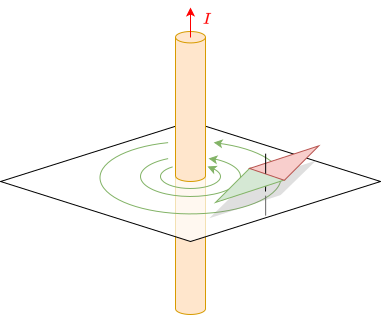
In 1820, Christian Ørsted discovered by chance during a lecture that current-carrying conductors also affect a compass. This experiment is illustrated in figure 3. A long, straight conductor with a circular cross-section has current $I$ flowing through it. Due to symmetry considerations, the field line pattern must be radially symmetric concerning the conductor axis. In an experiment with a magnetic needle, it can be shown that the field lines form concentric circles.
Ørsted found out, that the torque on the compass is
- proportional to the current $I$
- inversely proportional to the distance $r$ to the cable (= the radius)
The direction of the field here is coaxial circular around the wire.
For a detailed definition it is bes to use a cylintrical coordinate system. Then the magnetic field $\vec{H}$ is given as
\begin{align*}
\vec{H} = \left( \begin{matrix} H_r \\ H_\varphi \\ H_\theta \end{matrix} \right) = \left( \begin{matrix} 0 \\ H_\varphi \\ 0 \end{matrix} \right) \\
\end{align*}
The radial and axial part is zero - the field is curling around the wire.
For the azimutal magnetic field strength around a single conductor is defined as: \begin{align*} \boxed{H_\varphi ={I\over{l}} = {{I}\over{2 \cdot \pi \cdot r}}} \quad \quad | \quad \text{applies only to the long, straight conductor} \end{align*}
$l$ is here the length of a coaxial magnetic fieldline.
For the unit of the magnetic field strength $H$ we get $[H] = {{[I]}\over{[l]}}= \rm 1~{{A}\over{m}}$
Notice:

- If the technical direction of the current is considered, the magnetic field lines surround the current in the sense of a right-hand screw. (“right screw rule”)
- This rule can also be remembered in another way: If the thumb of the right hand points in the (technical) current direction, the fingers of the hand surround the conductor like the magnetic field lines. Likewise, if the thumb of the left hand points in the Electron flow direction, the fingers of the hand surround the conductor like the magnetic field lines.
Comparison of Electrostatics and Magnetostatics


Superposition of the magnetostatic Field
In the electric field, the field line density was a measure of the strength of the field. This is also used for the magnetic field. Looking at the simulations in Falstad (e.g. figure ##) with this understanding, one notices an inconsistency: contrary to the relationship just given, the field line density in the Falstad simulation not indicates the strength of the field. A realistic simulation is shown in figure 7 for comparison, which makes the difference clear: the field is stronger near the conductor. Thus the field line density must also be stronger there.
Attention:
- The density of the field lines is a measure of the field strength.
- The simulation in Falstad cannot represent this in this way.
Here the field strength is coded by the color intensity (dark green = low field strength, light green to white = high field strength).
Before the magnetic field strength will be considered in more detail, the simulation and superposition of the magnetic field will be discussed in more detail here.
Magnetostatic fields can be superposed, just like electrostatic fields. This allows the fields of several current-carrying lines to be combined into a single one. This trick is used in the following chapter to examine the magnetic field in more detail.
Below, the magnetic field of a single current-carrying conductor is shown. This was already derived in the previous chapter by symmetry considerations. The representation in the simulation can be simplified a bit here to see the conditions more clearly: Currently, the field lines are displayed in 3D, which is done by selecting Display: Field Lines and No Slicing. If you change the selection to Show Z Slice instead of No Slicing, you can switch to a 2D display. In this display, small compass needles can also show the magnetic field. To do this, select Display: Field Vectors instead of Display: Field Lines. In addition, a “magnetic sample”, i.e. a moving compass, can be found at the mouse pointer in the 2D display.
If there is another current-carrying conductor near the first conductor, the fields overlap. In the simulation below, the current of both conductors is directed in the same direction. The field between the conductors overlaps just enough to weaken. This can also be deduced by previous knowledge if just the middle point between both conductors is considered: There, for the left conductor the right-hand rule results in a vector directed towards the observer. For the right conductor, it results in a vector that is directed away from the observer. These just cancel each other out. Further outward field lines go around both conductors. The North and south poles here are not fixed localized toward the outside.
If, on the other hand, the current in the second conductor is directed in the opposite direction to the current in the first conductor, the picture changes: Here there is a reinforcing superposition between the two conductors. Using the nomenclature from the previous chapter, it is also possible to assign north and south poles locally. Towards the outside, one pole appears to be located in front of the two conductors and another one behind.
in both simulations, the distances between the conductors can also be changed using the Line Separation slider. What do you notice in each case when the two lines are brought close together?
Complex Geometry: toroidal Coil
Fig. ##: Magnetic field in a toroidal coil
A toroidal coil has a donut-like setup. This can be seen in figure ##.
For reasons of symmetry, it shall get clear that the field lines form concentric circles.
The magnetic field in a toroidal coil is often considered as homogenious.
In the following chapters the magnetic field will also be divided into a “causer field” (a field caused by magnets/currents) and an “acting field” (a field acting on a magnet/current).
Since the $H$-field focuses on the causing current ($M \sim I$) and does not give us a force depending on the value of second magnet/current, it is the causer field.
Common pitfalls
- …
Exercises
Exercise E1 Magnetic Field Lines
(written test, approx. 6 % of a 120-minute written test, SS2024)
The following setup shall be given:
- Four conductors are located perpendicular to the plane of the diagram
- All of them conduct a current with the same magnitude, but not in the same direction.
- A permanent magnet is located in between the conductors.
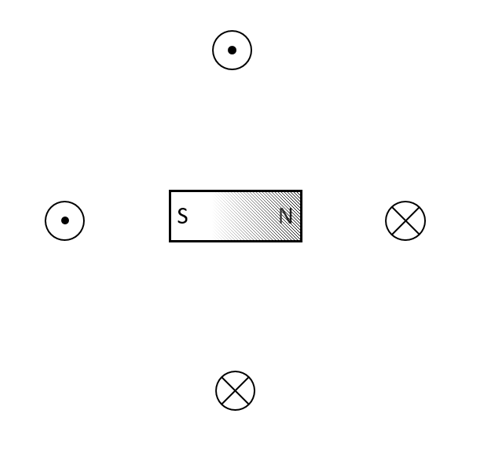
1. Do not consider the permanent magnet at first. Draw at least 10 field lines of the H-field qualitatively. Give a a correct representation of their direction, and density for the shown area.
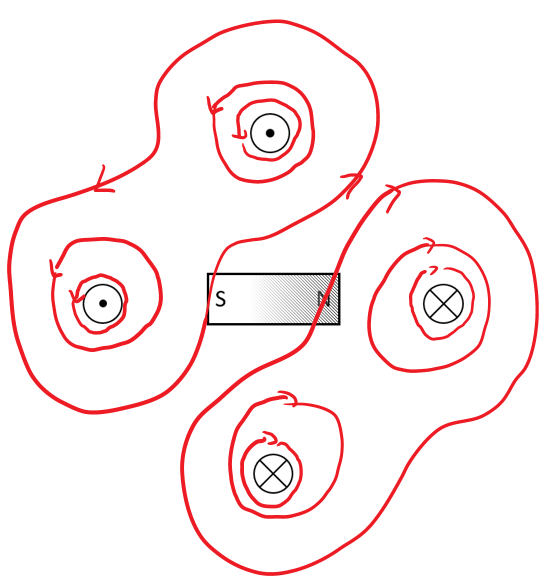
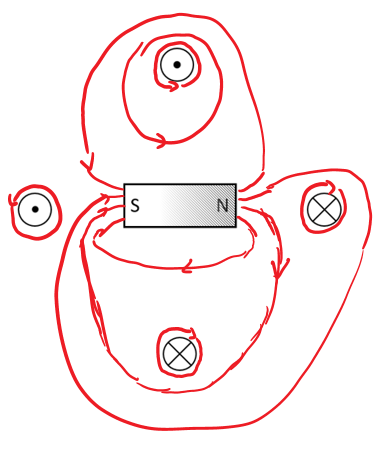
2. Discuss how the permanent magnet affects the H-field, based on the fundamental definition of the H-field.
- The H-field is defined by currents $\sum I = \int H {\rm d}s$ .
- In the permanent magnet, there are no free currents.
- The bound currents (of the permanent magnet) create also an H field.
- This exits on the north pole and enters the magnet on the south pole (similar to the B-field)_
- $H = B/\mu$
- The H-field from task 1 gets distracted
Task 3.2.1 Magnetic Field Strength around a horizontal straight Conductor
The current $I_0 = 100~\rm A$ flows in a long straight conductor with a round cross-section. The conductor shall have constant electric properties everywhere. The radius of the conductor is $r_{\rm L}= 4~\rm mm$.
1. What is the magnetic field strength $H_1$ at a point $P_1$, which is outside the conductor at a distance of $r_1 = 10~\rm cm$ from the conductor axis?
- The $H$-field is given as: the current $I$ through an area divided by the “specific” length $l$ of the closed path around the area. This shall give you the formula (when not in already known)
- The relevant current is the given $I_0$.
The $H$-field is given as: \begin{align*} H(r) &= {{I_0}\over{2\pi \cdot r}} \\ &= {{100~\rm A}\over{2\pi \cdot 0.1 ~\rm m}} \\ \end{align*}
2. What is the magnetic field strength $H_2$ at a point $P_2$, which is inside the conductor at a distance of $r_2 = 3~\rm mm$ from the conductor axis?
- Again, the $H$-field is given as: the current $I$ through an area divided by the “specific” length $l$ of the closed path around the area.
- Here, the relevant current is not the given one. There is only a fraction of the current flowing through the part of the conductor inside the $r_2$
The $H$-field is given as: \begin{align*} H(r) &= {{I}\over{2\pi \cdot r}} \end{align*}
But now $I$ is not $I_0$ anymore, but only a fraction, so $\Delta I$. $I_0$ is evenly distributed over the cross-section $A$ of the conductor. The cross-sectional area is given as $A= r^2 \cdot \pi$
So the current $\Delta I$ is given as: current divided by the full area and then times the fractional area: \begin{align*} \Delta I &= I_0 \cdot {{r_2^2 \cdot \pi}\over{r_{\rm L}^2 \cdot \pi}} \\ &= I_0 \cdot {{r_2^2 }\over{r_{\rm L}^2 }} \end{align*}
Therefore, the $H$-field is: \begin{align*} H(r) &= {{\Delta I}\over{2\pi \cdot r_2}} &&= {{I_0 \cdot {{ r_2^2}\over{r_{\rm L}^2}} }\over{2\pi \cdot r_2}} \\ &= {{I_0 \cdot {{ r_2}\over{r_{\rm L}^2}} }\over{2\pi}} &&= {{1}\over{2\pi}} I_0 \cdot {{ r_2}\over{r_{\rm L}^2}} \end{align*}
Task 3.2.2 Superposition

Three long straight conductors are arranged in a vacuum to lie at the vertices of an equilateral triangle (see figure 8). The radius of the circumcircle is $r = 2 ~\rm cm$; the current is given by $I = 2 ~\rm A$.
1. What is the magnetic field strength $H({\rm P})$ at the center of the equilateral triangle?
- The formula for a single wire can calculate the field of a single conductor.
- For the resulting field, the single wire fields have to be superimposed.
- Since it is symmetric the resulting field has to be neutral.
In general, the $H$-field of the single conductor is given as: \begin{align*} H &= {{I}\over{2\pi \cdot r}} \\ &= {{2~\rm A}\over{2\pi \cdot 0.02 ~\rm m}} \\ \end{align*}
- However, even without calculation, the constant distance between point $\rm P$ and the three conductors dictates, that the $H$-field has a similar magnitude.
- By the symmetry of the conductor, the angles of the $H$-field vectors are defined and evenly distributed on the revolution:

2. Now, the current in one of the conductors is reversed. To which value does the magnetic field strength $H({\rm P})$ change?
- Now, the formula for a single wire has to be used to calculate the field of a single conductor.
- For the resulting field, the single wire fields again have to be superimposed.
- The symmetry and the result of question 1 give a strong hint about how much stronger the resulting field has to be compared to the field of the reversed one.
The $H$-field of the single reversed conductor $I_3$ is given as: \begin{align*} H(I_3) &= {{I}\over{2\pi \cdot r}} \\ &= {{2~\rm A}\over{2\pi \cdot 0.02 ~\rm m}} \\ \end{align*}
Once again, one can try to sketch the situation of the field vectors:

Therefore, it is visible, that the resulting field is twice the value of $H(I_3)$:
The vectors of $H(I_1)$ plus $H(I_2)$ had in the task 1 just the length of $H(I_3)$.
Exercise E2 Magnetic Field Lines
(written test, approx. 4 % of a 120-minute written test, SS2021)
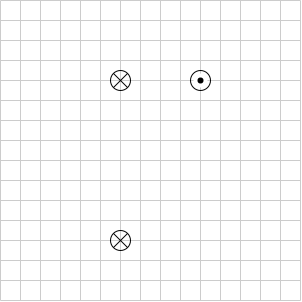
Several parallel conductors are projecting out of the plane.
The same current $|I|$ flows through all the conductors in different directions (see image below).
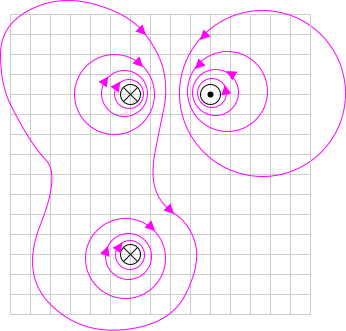
Sketch at least 10 field lines of the magnetic field strength $\vec{H}$ in such a way that the different properties of the field lines (e.g. direction and density) can be seen.
- high density of field lines near the conductors
- direction of the field lines given by the right-hand rule
- magnetic field has closed field lines
- resulting field given by superposition of field lines
Embedded resources
The following video gives a similar introduction
Superposition of magnetic fields