This is an old revision of the document!
Block 20 — Electromagnetic Induction and Energy
Learning objectives
- …
Preparation at Home
Well, again
- read through the present chapter and write down anything you did not understand.
- Also here, there are some clips for more clarification under 'Embedded resources' (check the text above/below, sometimes only part of the clip is interesting).
For checking your understanding please do the following exercises:
- …
90-minute plan
- Warm-up (x min):
- ….
- Core concepts & derivations (x min):
- …
- Practice (x min): …
- Wrap-up (x min): Summary box; common pitfalls checklist.
Conceptual overview
- …
Core content
Self-Induction
Up to now, we investigated the induction of electric voltages and currents based on the change of an external flux ${\rm d}\Psi / {\rm d}t$. For the induced current $i_{\rm ind}$, we found that it counteracts the change of the external flux (Lenz law).
But what happens, when there is no external field - only a coil which creates the flux change itself (see figure 1)?

To understand this, we will investigate the situation for a long coil (figure 2).

The created field density of the coil can be derived from Ampere's Circuital Law
\begin{align*} \theta(t) &= \int & \vec{H}(t) \cdot {\rm d}\vec{s} \\ &= \int & \vec{H}_{\rm inner}(t) \cdot {\rm d}\vec{s} & + & \int \vec{H}_{\rm outer}(t) \cdot {\rm d} \vec{s} \\ &= \int & \vec{H}(t) \cdot {\rm d}\vec{s} & + & 0 \\ &= & {H}(t) \cdot l \\ \end{align*}
With magnetic voltage $\theta(t) = N \cdot i$ this lead to the magnetic flux density $B(t)$
\begin{align*} N \cdot i &= {H}(t) \cdot l \\ {H}(t) &= {{N \cdot i }\over {l}} \\ {B}(t) &= \mu_0 \mu_{\rm r} \cdot {{N \cdot i }\over {l}} \\ \end{align*}
Based on the magnetic flux density $B(t)$ it is possible to calculate the flux $\Phi(t)$:
\begin{align*} \Phi(t) &= \iint_A \vec{B}(t) \cdot {\rm d}\vec{A} \\ &= \iint_A \mu_0 \mu_{\rm r} \cdot {{N \cdot i }\over {l}} \cdot {\rm d}A \\ &= \mu_0 \mu_{\rm r} \cdot {{N \cdot i }\over {l}} \cdot A \\ \end{align*}
The changing flux $\Phi$ is now creating an induced electric voltage and current, which counteracts the initial change of the current. This effect is called Self Induction. The induced electric voltage $u_{\rm ind}$ is given by:
\begin{align*} u_{\rm ind} &= - N \cdot {{{\rm d} \Phi(t)}\over{{\rm d}t}} \\ &= - N \cdot {{{\rm d} (\mu_0 \mu_{\rm r} \cdot {{N \cdot i }\over {l}} \cdot A)}\over{{\rm d}t}} \\ &= - N \cdot \mu_0 \mu_{\rm r} \cdot {{N \cdot A }\over {l}} \cdot {{{\rm d}i}\over{{\rm d}t}} \\ \end{align*}
\begin{align*} \boxed{ u_{\rm ind} = - \mu_0 \mu_{\rm r} \cdot N^2 \cdot {{A }\over {l}} \cdot {{{\rm d}i}\over{{\rm d}t}} \\ } \\ \text{for a long coil} \end{align*}
The result means that the induced electric voltage $u_{\rm ind}$ is proportional to the change of the current ${{\rm d}\over{{\rm d}t}}i$. The proportionality factor is also called Self-inductance $L$ (or often simply called inductance).
4.5 Inductance
The inductance is another passive basic component of the electric circuit. Besides the ohmic resistor $R$ and the capacitor $C$, the inductor $L$ is the lump component entailing the inductance.
Generally, the inductance is defined by: \begin{align*} \boxed{ L = \left|{{u_{\rm ind}}\over{{\rm d}i / {\rm d}t}}\right| \\ } \end{align*}
The inductance $L$ can also be described differently based on Lenz law $u_{\rm ind} = - {{\rm d}\over{{\rm d}t}}\Psi(t)$ :
\begin{align*} L &= \left|{{u_{\rm ind}}\over{{\rm d}i / {\rm d}t}}\right| \\ &= {{{d \Psi(t)}/{dt}}\over{{\rm d}i / {\rm d}t}} \\ \end{align*}
\begin{align*} \boxed{ L = {{ \Psi(t)}\over{i}} } \end{align*}
One can also consider an inductor a “conservative person”: it does not like to see abrupt changes in the passing current. It reacts to any change in the current with a counteracting voltage since the current change leads to a changing flux and - therefore - an induced voltage. The figure 3 shows an inductor in series with a resistor and a switch (any real switch also behaves as a capacitor, when open). Once the simulation is started, the inductor directly counteracts the current, which is why the current only slowly increases.
The unit of the inductance is $\rm 1 ~Henry = 1 ~H = 1 {{Vs}\over{A}} = 1{{Wb}\over{A}} $
Mathematically the voltages can be described in the following way:
\begin{align*} u_0 &= u_R &+ &u_L \\ &= i \cdot R & + & {{{\rm d}\Psi}\over{{\rm d}t}} \\ &= i \cdot R & + &L \cdot {{{\rm d}i}\over{{\rm d}t}} \\ \end{align*}
Inductance of different Components
Long Coil
In the last sub-chapter, the formula of a long coil was already investigated. By these, the inductance of a long coil is
\begin{align*} \boxed{L_{\rm long \; coil} = \mu_0 \mu_{\rm r} \cdot N^2 \cdot {{A }\over {l}}} \end{align*}
Toroidal Coil
The toroidal coil was analyzed in the last chapter(see magnetic Field Strength Part 1: Toroidal Coil). Here, a rectangular intersection a assumed (see figure 4).

This leads to
\begin{align*} H(t) = {{N \cdot i}\over {l}} \end{align*}
with the mean magnetic path length (= length of the average field line) $l = \pi(r_{\rm o} + r_{\rm i})$:
\begin{align*} H(t) = {{N \cdot i}\over { \pi(r_{\rm o} + r_{\rm i})}} \end{align*}
The inductance $L$ can be calculated by
\begin{align*} L_{\rm toroidal \; coil} &= {{ \Psi(t)}\over{i}} \\ &= {{ N \cdot \Phi(t)}\over{i}} \\ \end{align*}
With the magnetic flux density $B(t) = \mu_0 \mu_{\rm r} H(t) = \mu_0 \mu_{\rm r} {{i \cdot N }\over {l}}$ and the cross section $A = h (r_{\rm o} - r_{\rm i})$, we get:
\begin{align*} \quad \quad L_{\rm toroidal \; coil} &= {{ N \cdot \mu_0 \mu_{\rm r} {{i \cdot N } \over { \pi(r_{\rm o} + r_{\rm i})}} \cdot h(r_{\rm o} - r_{\rm i})}\over{i}} \\ &= {{ N^2 \cdot \mu_0 \mu_{\rm r} \cdot h(r_{\rm o} - r_{\rm i})}\over{ \pi(r_{\rm o} + r_{\rm i})}} \\ \end{align*}
\begin{align*} \boxed{ L_{\rm toroidal \; coil} = \mu_0 \mu_{\rm r} \cdot N^2 \cdot {{ h(r_{\rm o} - r_{\rm i})}\over{ \pi(r_{\rm o} + r_{\rm i})}} } \end{align*}
Common pitfalls
- …
Exercises
Exercise E16 Self-Induction
(written test, approx. 8 % of a 120-minute written test, SS2024)
A coil with a length of $30 ~\rm cm$ and a radius of $2 ~\rm cm$ has $500$ turns.
The current through the coil changes linearly from $0$ to $3 ~\rm A$ in $0.02 ~\rm ms$.
The arrangement is located in air ($\mu_{\rm r}=1$).
$\mu_0= 4\pi \cdot 10^{-7} ~\rm Vs/Am$
1. Calculate the (self-)inductance of the coil.
2. Determine the induced voltage in the coil during the change in current.
Exercise E12 Self Induction
(written test, approx. 8 % of a 120-minute written test, SS2022)
Accidentally, a motor with an inductance of $L=50 ~\rm \mu H$ is connected to a DC voltage source, which is fused with a circuit breaker.
The circuit breaker opens the circuit At $t_0=0$ with a current of $I=63 ~\rm A$. The current is reduced linearly down to $0 ~\rm A$ within $1 ~\rm \mu s$.
(The inner resistance of the motor shall be neglected.)
1. Draw the circuit (the circuit breaker can be drawn as a switch), with all voltage and current arrows.

2. What is the maximum magnitude of the voltage, which the circuit breaker has to withstand?
Sketch the diagrams $i(t)$ and $u_{\rm ind} (t)$ with the calculated value of the induced voltage.
- external voltage of the voltage source $U_\rm s$
- voltage $u_{\rm ind} (t)$ induced by the change of the current
The first one is not given in the exercise, and therefore not considered here.
The induced voltage can be calculated by linearizing the following: \begin{align*} u_{\rm ind} (t) &= - L {{ {\rm d} i}\over{ {\rm d} t }}\\ \rightarrow u_{\rm ind} (t) &= - L {{ \Delta i}\over{ \Delta t }}\\ \end{align*}
With the given details: \begin{align*} u_{\rm ind} (t) &= - L {{ 0 - I}\over{ t_1 - t_0 }}\\ &= 50 \cdot 10^{-6} {~\rm H} {{ 63 ~\rm A}\over{ 1 \cdot 10^{-6} ~\rm s}}\\ &= 3150 {{ ~\rm Vs}\over{ ~\rm A}} \; {{ ~\rm A}\over{ ~\rm s}}\\ \end{align*}

Exercise 4.5.1 Self Induction I
Calculate the inductance for the following settings
1. Cylindrical long air coil with $N=390$, winding diameter $d=3.0 ~\rm cm$ and length $l=18 ~\rm cm$
\begin{align*} L_1 &= \mu_0 \mu_{\rm r} \cdot N^2 \cdot {{A }\over {l}} \\ &= 4\pi \cdot 10^{-7} {\rm {{H}\over{m}}} \cdot 1 \cdot (390)^2 \cdot {{\pi \cdot (0.03~\rm m)^2 }\over {0.18 ~\rm m}} \end{align*}
2. Similar coil geometry as explained in 1. , but with double the number of windings
3. Two coils as explained in 1. in series
4. Similar coil geometry and number of windings as explained in 1. , but with an iron core ($\mu_{\rm r}=1000$)
Exercise 4.5.2 Self Induction II
A cylindrical air coil (length $l=40 ~\rm cm$, diameter $d=5.0 ~\rm cm$, and a number of windings $N=300$) passes a current of $30 ~\rm A$. The current shall be reduced linearly in $2.0 ~\rm ms$ down to $0.0 ~\rm A$.
What is the amount of the induced voltage $u_{\rm ind}$?
The requested induced voltage can be derived by:
\begin{align*} L &= \left|{{u_{\rm ind}}\over{{\rm d}i / {\rm d}t}}\right| \\ \rightarrow \left|u_{\rm ind}\right| &= L \cdot \left|{{{\rm d}i}\over{{\rm d}t}}\right| \\ &= L \cdot \left|{{\Delta i}\over{\Delta t}}\right| \\ \end{align*}
Therefore, we just need the inductance $L$, since ${{\Delta i}\over{\Delta t}}$ is defined as $30 ~\rm A$ per $2 ~\rm ms$:
\begin{align*} L &= \mu_0 \mu_{\rm r} \cdot N^2 \cdot {{A }\over {l}} \\ \end{align*}
So, the result can be derived as: \begin{align*} \left|u_{\rm ind}\right| &= \mu_0 \mu_{\rm r} \cdot N^2 \cdot {{A }\over {l}} \cdot \left|{{\Delta i}\over{\Delta t}}\right| \\ &= 4\pi \cdot 10^{-7} {\rm {{H}\over{m}}} \cdot 1 \cdot (300)^2 \cdot {{\pi \cdot (0.05~\rm m)^2 }\over {0.40 ~\rm m}} \cdot {{30 ~\rm A}\over{2 ~\rm ms}} \end{align*}
Exercise 4.5.3 Self Induction III
A coil with the inductance $L=20 ~\rm µH$ passes a current of $40 ~\rm A$. The current shall be reduced linearly in $5 ~\rm µs$ down to $0 ~\rm A$ (see figure 5).
- What is the amount of the induced voltage $u_{\rm ind}$?
- Sketch the course of $u_{\rm ind}(t)$!

Exercise E11 Coil in a magnetic Field
(written test, approx. 4 % of a 120-minute written test, SS2021)
A coil with $n = 300$ turns and a cross-sectional area $A = 600 ~\rm cm^2$ is located in a homogeneous magnetic field.
The rotation of the coil causes a sinusoidal change in the magnetic field in the coil with the frequency $f = 80~\rm Hz$.
The maximum value of the magnetic flux density in the coil is $\hat{B} = 2 \cdot 10^{-6} ~\rm {{Vs}\over{cm^2}}$.
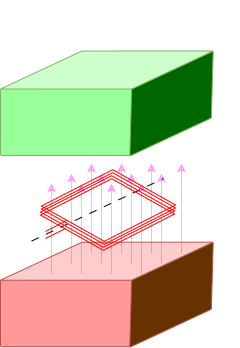
Derive the formula for the voltage induced in the coil and calculate the voltage amplitude.
The induced voltage $u_{\rm ind}$ is given by:
\begin{align*} u_{\rm ind} &= - {{{\rm d}\Psi(t)}\over{{\rm d}t}} \\ &= - n{{{\rm d}\Phi(t)}\over{{\rm d}t}} \\ \end{align*}
With $\Phi(t)= B(t) \cdot A$, where $A$ is the constant area of a single winding and $B(t)$ is the changing field through this winding.
Due to the rotation, the field changes as:
\begin{align*} B(t) &= \hat{B} \cdot \sin(\omega t + \varphi) \\ &= \hat{B} \cdot \sin(2\pi f \cdot t + \varphi) \\ \end{align*}
This leads to: \begin{align*} u_{\rm ind} &= - n{{{\rm d}}\over{{\rm d}t}}A \hat{B} \cdot \sin(2\pi f \cdot t + \varphi) \\ &= - n \cdot A \hat{B} \cdot 2\pi f \cdot \cos(2\pi \cdot f t + \varphi) \\ \end{align*}
The absolute value of the factor in front of the $\cos$ is the maximum induced voltage $\hat{U}_{\rm ind}$: \begin{align*} \hat{U}_{\rm ind} &= n \cdot A \hat{B} \cdot 2\pi f \\ &= 300 \cdot 0.06{~\rm m^2} \cdot 2 \cdot 10^{-2} ~\rm {{Vs}\over{m^2}} \cdot 2\pi \cdot 80 {{1}\over{\rm s}} \\ &= 180.95... {~\rm m^2} \cdot {{\rm Vs}\over{\rm m^2}} \cdot {{1}\over{\rm s}} \\ &= 180.95... {~\rm V} \\ \end{align*}
Exercise E10 effect of induction
(written test, approx. 5 % of a 120-minute written test, SS2021)
A single conductor loop is penetrated by a changing magnetic flux.
The following figure shows the variation of the flux $\Phi(t)$ over time.
Calculate the variation of the induced voltage $u_{\rm ind}(t)$ over time and draw it in a separate diagram.

Based on Faraday's Law of Induction the induced voltage is given by: \begin{align*} u_{\rm ind} =& - {{ {\rm d} }\over{ {\rm d}t}} \Psi(t) \bigg\rvert_{n=1}\\ =& - {{ {\rm d} }\over{ {\rm d}t}} \Phi(t) \\ \end{align*}
For a linear function, the derivative can be substituted by Deltas ($\rm d \rightarrow \Delta$):
\begin{align*}
u_{\rm ind} = - {{ \Delta \Phi(t)}\over{ \Delta t}} = - { { \Phi(t_{\rm n+1} ) - \Phi(t_{\rm n} ) } \over { t_{\rm n+1} - t_{\rm n} } } \\
\end{align*}
For a piece-wise linear function, the induced voltage can be calculated for each interval.
Here, there are 5 different intervals - in the following called $\rm I$ to $\rm V$ from left to right:

- For the intervals $\rm I$, $\rm III$, and $\rm V$ , the flux $\Phi(t)$ is constant. Therefore, $\Delta \Phi(t)=0$ and $u_{\rm ind}(t)=0{~\rm V}$

- For the interval $\rm II$:
- The change in the flux is: $ \Delta \Phi(t) = 1.5 \cdot 10^{-4} {~\rm Vs} - 4.5 \cdot 10^{-4} {~\rm Vs}= - 3.0 \cdot 10^{-4} {~\rm Vs}$
- The time span is: $0.2 ~\rm s$
- Conclusively, the induced voltage is: $u_{\rm ind}(t) = + {{3.0 \cdot 10^{-4} {~\rm Vs}} \over {0.2 ~\rm s} } = 1.5 {~\rm mV}$

- For the interval $\rm IV$:
- The change in the flux is: $ \Delta \Phi(t) = 0 \cdot 10^{-4} {~\rm Vs} - 1.5 \cdot 10^{-4} {~\rm Vs}= - 1.5 \cdot 10^{-4} {~\rm Vs}$
- The time span is: $0.2 ~\rm s$
- Conclusively, the induced voltage is: $u_{\rm ind}(t) = + {{1.5 \cdot 10^{-4} {~\rm Vs}} \over {0.2 ~\rm s} } = 0.75 {~\rm mV}$


Embedded resources
Explanation (video): …